How to Work Remotely from Another Country (Complete Beginner Guide)
Imagine waking up to the sound of ocean waves in Bali, opening your laptop, and starting your workday, all while earning in dollars or pounds. This is not a fantasy. Millions of people around the world are already working remotely from another country, and with the right plan, you can too. Whether you are a freelancer, an employee, or someone just starting out, this guide will walk you through every step you need to take to make it happen.
This guide is written for anyone who has ever considered leaving their home country to work abroad but did not know where to begin. Maybe you are a fresh graduate looking for freedom, a remote employee who wants to explore the world, or a freelancer tired of the same four walls. Whatever your background, this guide is for you.
Working remotely from another country is more possible today than at any point in history. The global shift toward remote work has opened doors that were once only available to a lucky few. Companies now hire talent from anywhere. Freelancers serve clients across time zones. Entrepreneurs build businesses from laptops in cafes in Chiang Mai or Lisbon.
In this guide, you will learn what remote work abroad actually means, whether it is legal, what visa options exist, how to find remote income, what tools you need, and how to plan your budget. By the end, you will have a clear, step-by-step roadmap to take your first confident step toward working abroad.
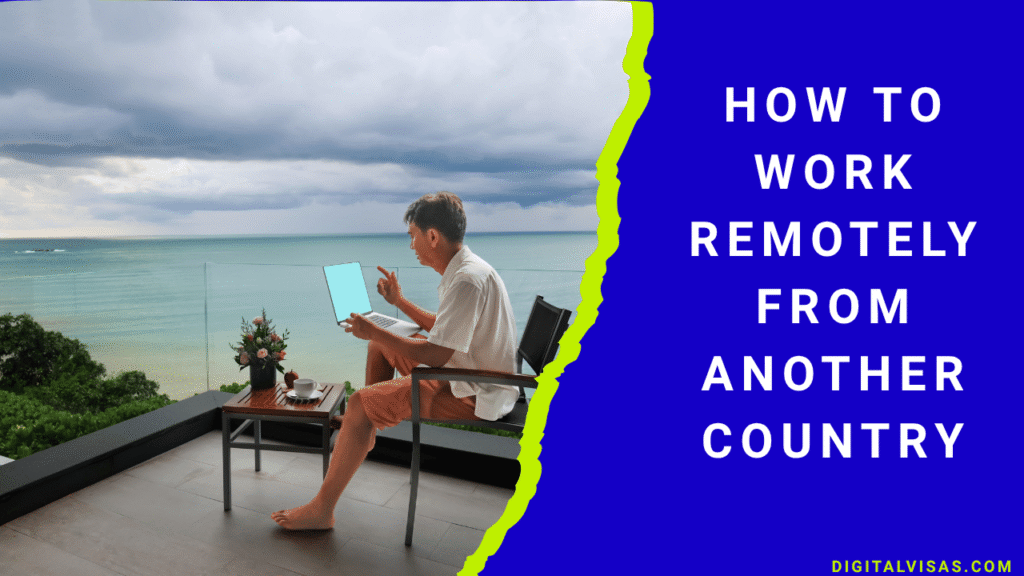
What Does It Mean to Work Remotely from Another Country?
Working remotely from another country simply means doing your job or running your business from a country that is not your home country, using the internet as your primary tool. Instead of commuting to an office, you use a laptop, a reliable internet connection, and digital tools to stay connected with your employer, clients, or customers, no matter where in the world you are sitting.
This lifestyle goes by many names. Some people call themselves digital nomads. Others are remote employees on an extended working holiday. Some are freelancers who travel slowly from one country to the next, spending weeks or months in each location before moving on.
The work itself can be anything that does not require your physical presence, writing, coding, designing, customer support, consulting, marketing, teaching English online, managing social media, and hundreds of other professions. As long as you have a laptop and wifi, your “office” can be a co-working space in Medellin, a rented apartment in Prague, or a cafe in Kyoto.
The concept has exploded in popularity since 2020, when the COVID-19 pandemic proved that remote work functions at scale. Today, this is one of the fastest-growing global lifestyle trends, attracting people from India, the UK, the USA, and dozens of other countries.
Can You Work Remotely from Another Country Legally?
This is the most important question every aspiring remote worker needs to ask, and the honest answer is: it depends on your situation and the country you are visiting.
Most countries allow tourists to enter and stay for a limited period, typically 30 to 90 days. If you are working online for a foreign employer or foreign clients while on a tourist visa, you are generally not working for the local economy, and many countries technically permit this, though very few explicitly authorize it in writing.
However, the legal landscape is evolving rapidly. Over 60 countries now offer official Digital Nomad Visas or Remote Work Visas, including Portugal, Spain, Germany, Thailand, Barbados, Costa Rica, and Indonesia. These visas are specifically designed for remote workers and freelancers who earn income from outside the host country. They offer legal clarity, longer stays, and, in some cases, tax benefits.
What you must never do is take up local employment, meaning work for a company in the country you are visiting, on a tourist visa. That is illegal in virtually every country. If you plan to stay long-term, always research the visa requirements for your nationality and destination. Consulting an immigration lawyer or a relocation specialist is always a smart investment.
Types of Remote Work Setups
Before packing your bags, you need to understand what type of remote work arrangement you are operating under. The legal, financial, and logistical requirements will vary significantly depending on whether you are a remote employee, a freelancer, or an online business owner. Each setup has its own advantages and challenges, and knowing which category you fall into will help you plan more effectively. Let us break down the three main types of remote work setups in detail.
Remote Job (Employee)
A remote job means you are a salaried employee of a company, but you work from wherever you choose instead of a fixed office. Your employer pays you a regular salary, provides benefits, and likely uses tools like Slack, Zoom, and Google Meet to keep the team connected. Working remotely as an employee is one of the most stable ways to live abroad because your income is predictable.
However, there are complications. Your employer may have restrictions on which countries you can work from for legal and tax reasons. Some companies only allow remote work within specific countries or time zones. Before relocating, always have an honest conversation with your employer about your plans. Get written approval. Make sure your employment contract permits working from another country. This protects both you and your employer from compliance issues.
Freelancing
Freelancing means you offer your skills to multiple clients on a project-by-project or contract basis. You are self-employed, which gives you the most flexibility in terms of where and when you work. Popular freelancing fields include writing, graphic design, web development, video editing, digital marketing, virtual assistance, and translation.
Platforms like Upwork, Fiverr, Toptal, and PeoplePerHour make it easy to find clients from anywhere in the world. As a freelancer working abroad, you are typically earning income from foreign clients, which generally does not count as working locally, meaning tourist visas are often used by freelancers, though a digital nomad visa is always the safer and more legally sound option. Income can be variable, so having 3 to 6 months of savings as a buffer is strongly recommended before going freelance abroad.
Online Business
Running an online business means you own and operate a digital business that generates income — whether through e-commerce, a blog with advertising revenue, an online course, a SaaS product, a YouTube channel, or affiliate marketing. This is often the most financially rewarding model, but it also takes the most time to build from scratch.
Online business owners have the greatest location independence because they are not tied to any single client or employer. However, business registration, taxation, and banking can be complex when you are based abroad. Many online entrepreneurs register their businesses in countries like Estonia (through e-Residency), Singapore, or the UK for simplicity. If this is your path, it is worth consulting a tax advisor with international experience to structure your business correctly from day one.
Step-by-Step Guide to Working Remotely Abroad
Now that you understand the concept and the types of remote work, let us get into the practical steps. Working remotely from another country is not something you should do impulsively. It requires solid preparation across multiple areas: income, visa, accommodation, finances, and tools. Many people fail not because they lack the skill or the desire, but because they underestimate the planning involved. Follow these six steps in order, and you will be far better prepared than most people who make this leap.
Step 1: Choose a Remote Job or Skill
Before anything else, you need a reliable source of remote income. If you already have a remote job or established freelance clients, you are ahead of the curve. If not, your first priority is to develop a skill that can be done entirely online. Some of the most in-demand remote skills today include web development, UI/UX design, copywriting, SEO, social media management, online tutoring, data analysis, and virtual assistance.
Platforms like Coursera, Udemy, and LinkedIn Learning offer affordable courses to help you build these skills quickly. Spend 2 to 6 months genuinely developing your skill before you commit to moving abroad. Try to land at least one paying client or secure your employer’s remote work approval before booking any flights. Income security is the single most important factor in a successful move abroad.
Step 2: Choose Your Destination
Not every country is equally suited to remote work. Your ideal destination depends on several factors: cost of living, internet quality, visa availability, safety, time zone alignment with your clients, and personal lifestyle preferences. Countries like Thailand, Portugal, Mexico, Georgia (the country), Indonesia, and Colombia have become extremely popular among remote workers because they offer affordable living, strong infrastructure, and vibrant communities of like-minded people.
Start by researching 3 to 5 countries that appeal to you. Use resources like Numbeo for cost-of-living comparisons and Nomad List for overall remote-work suitability scores. Consider starting with a country closer to your home time zone to minimize disruption to your work schedule, especially if you are a remote employee with fixed meeting times.
Step 3: Check Visa Requirements
Once you have chosen a destination, research the visa requirements specific to your nationality. Every country has different entry rules, and they change frequently. Start with the official government immigration website of your destination country, or use a reliable visa information service.
Check how long you can stay on a tourist visa, whether a digital nomad visa exists for that country, whether you need to show proof of income or health insurance, and what the application process involves. For long stays of 3 months or more, always apply for the most appropriate visa rather than overstaying a tourist visa. Overstaying carries serious consequences, including fines, deportation, and future entry bans. Many countries now offer specific digital nomad visas that are well worth exploring before you travel.
Step 4: Plan Your Budget
Financial planning is non-negotiable. You need to calculate both your expected monthly income and expenses in your destination country. Include rent, food, transport, co-working space memberships, health insurance, travel insurance, visa fees, flights, entertainment, and an emergency fund.
A common rule of thumb is to save at least 3 to 6 months of living expenses in addition to your regular income before relocating. This buffer protects you from income gaps, unexpected expenses, or visa complications. Use a spreadsheet to map out your income versus expenses in detail. Living abroad can be significantly cheaper than living in Western countries. For example, a comfortable lifestyle in Chiang Mai, Thailand, can cost as little as $1,000 to $1,500 USD per month, including rent, food, and activities.
Step 5: Arrange Accommodation
Finding accommodation before you arrive removes a huge source of stress. For your first month in a new country, consider staying in a serviced apartment, hostel private room, or short-term Airbnb rental. This gives you time to explore neighborhoods, understand local pricing, and find longer-term housing without rushing into a decision.
After your first month, you can usually negotiate a much better monthly rate directly with landlords. Apps like Facebook Marketplace, local expat groups, and country-specific websites are often more effective than Airbnb for longer stays. Look for accommodation with fast, reliable Wi-Fi, which is essential for remote work. Always test the internet speed before committing to a place. Ask the landlord to send you a screenshot of a recent speed test if you are booking in advance.
Step 6: Set Up Banking & Finances
Managing money across borders requires careful planning. Before you leave your home country, open a multi-currency bank account or travel-friendly account with a service like Wise (formerly TransferWise), Revolut, or Charles Schwab (for US residents). These accounts allow you to hold, send, and receive money in multiple currencies with minimal fees.
Avoid relying on your regular domestic bank account abroad, as foreign transaction fees and poor exchange rates can significantly eat into your earnings. Set up a payment method to receive income from clients or your employer. PayPal, Wise, Stripe, and direct SWIFT bank transfers are commonly used internationally. Also, inform your home bank of your travel plans to prevent your card from being blocked. Keep a small amount of local currency as emergency cash when you arrive.
How to Choose the Right Country
Choosing the right destination is one of the most exciting and most important decisions you will make as a remote worker. The country you choose will affect your daily quality of life, your productivity, your expenses, and your overall experience of living abroad. There is no single “best” country for everyone. The right choice depends on your budget, your lifestyle preferences, the nature of your work, and the visa options available to your nationality. Here are the four key factors to weigh carefully when making your decision.
Cost of Living
Cost of living is often the most decisive factor for remote workers, especially those starting out. If you earn in a strong currency like USD, GBP, or EUR, moving to a country with a lower cost of living can dramatically increase your quality of life. Countries in Southeast Asia, Eastern Europe, and Latin America often offer excellent living standards at a fraction of what you would pay in the UK, USA, or Australia.
For example, a comfortable one-bedroom apartment in Tbilisi, Georgia, costs around $400 to $600 per month. The same in Lisbon, Portugal, might cost $1,200 to $1,800. Meanwhile, a comparable apartment in London could easily run $2,500 or more. Use tools like Numbeo, Expatistan, or Nomad List to compare costs across cities, and always factor in not just rent but food, transport, healthcare, and entertainment.
Internet & Work Setup
Reliable, fast internet is not optional for remote workers; it is as essential as electricity. Before selecting a destination, research the average internet speeds and reliability in that country. Countries like South Korea, Japan, Portugal, Singapore, and Estonia consistently rank among the best in the world for internet connectivity.
Even within a country, internet quality can vary significantly between cities and rural areas. Consider co-working spaces if your accommodation’s internet is unreliable. Cities like Chiang Mai, Bali, Medellín, and Tbilisi have thriving co-working ecosystems with fast wifi, meeting rooms, and communities of remote workers. Having a local SIM card with a generous data plan as a backup is also a wise move. This becomes your lifeline if your home wifi goes down during an important meeting.
Visa Availability
The ease of obtaining a visa or the availability of a digital nomad visa should play a major role in your country selection. As of 2024, over 60 countries offer some form of digital nomad or remote work visa, including Portugal, Spain, Greece, Germany, Thailand, Indonesia (Bali), Costa Rica, Barbados, and Croatia. These specialized visas allow you to live and work legally for extended periods, often ranging from 6 months to 2 years.
Your nationality also matters greatly. Citizens of some countries enjoy visa-free or visa-on-arrival access to a wide range of destinations, while others face more restrictions. Always verify visa availability using your specific passport before committing to a destination. Government immigration websites are always the most reliable source of current information. A country with a straightforward, well-documented visa process will save you enormous stress compared to one with ambiguous or bureaucratic requirements.
Safety & Lifestyle
Safety is a fundamental consideration that is sometimes overlooked by enthusiastic first-time remote workers. Research crime rates, political stability, and overall safety conditions in any country you are considering. Resources like the Global Peace Index, travel advisories from your home government, and expat forums can give you a realistic picture of day-to-day safety.
Beyond safety, think about lifestyle fit. Do you want bustling city energy or peaceful beachside living? Do you want a large English-speaking expat community, or do you prefer to immerse yourself in local culture? Are you looking for outdoor adventure, rich food culture, nightlife, or spiritual retreats? Countries like Thailand offer all of the above, while quieter destinations like Slovenia or Uruguay may suit those who prefer a more relaxed pace. Your mental well-being and daily happiness matter just as much as your productivity.
Visa & Legal Requirements
Understanding the visa and legal landscape before you move is critical. Getting this wrong can lead to fines, deportation, or being banned from re-entering a country you love. The good news is that the world is becoming more accommodating for remote workers, with dozens of countries now offering dedicated digital nomad visa programs.
Here is what you need to know as a starting point. Most countries allow you to enter on a tourist visa for 30 to 90 days. During this time, working for foreign employers or clients online is generally tolerated, though rarely formally authorized. For stays longer than 90 days, you will typically need a proper long-stay visa, residency permit, or a digital nomad visa.
Key documents you may need include proof of remote employment or freelance income (bank statements, contracts, employer letters), proof of health insurance coverage, a clean criminal background check, and a valid passport with sufficient remaining validity. Income requirements vary by country. Portugal’s Digital Nomad Visa requires proof of at least four times the Portuguese minimum wage, while other countries set their own thresholds.
Tax obligations are another critical legal area. Many countries have tax treaties that prevent double taxation, but you still need to understand your tax responsibilities in both your home and host countries. Consulting a tax professional with international experience is strongly recommended before making any long-term move abroad.
How to Earn Money While Working Abroad
The most common concern for anyone considering remote work abroad is straightforward: how will I make money? The good news is that the opportunities are more plentiful than ever before. Whether you are seeking traditional remote employment or want to build income streams as a freelancer or entrepreneur, there are proven paths available to almost anyone with a digital skill.
For those seeking remote employment, job boards like Remote.Co, We Work Remotely, FlexJobs, LinkedIn Remote Jobs, and Himalayas are excellent starting points. Tech roles like software development, data engineering, and product management tend to pay the highest remote salaries, but there is also strong demand for marketing professionals, content writers, customer success managers, graphic designers, and online educators.
Freelancers can build income on platforms like Upwork, Fiverr, Toptal, and 99designs. Building a portfolio, gathering testimonials, and specializing in a niche will accelerate your ability to earn competitively. Online business owners can monetize through affiliate marketing, selling digital products or courses, dropshipping, print-on-demand, YouTube ad revenue, and newsletter sponsorships. Diversifying your income sources is a smart long-term strategy — relying on a single client or income stream creates vulnerability. Aim to have at least two or three income sources as you scale your remote lifestyle.
Tools & Setup You Need
Having the right tools is what separates productive remote workers from those who constantly struggle. Before you travel, invest in setting up a solid digital toolkit. The essentials go beyond just a laptop; your entire work infrastructure needs to function reliably from wherever you are in the world.
Here are the essential categories and recommended tools:
- Communication: Slack for team messaging, Zoom or Google Meet for video calls, WhatsApp for quick communication with clients.
- Project Management: Notion, Trello, Asana, or Monday.com to organize tasks and deadlines.
- File Storage & Collaboration: Google Drive or Dropbox for accessing your files from any device, anywhere.
- VPN: A reliable VPN such as NordVPN or ExpressVPN is essential for secure browsing, especially on public wifi networks in cafes and co-working spaces. It also helps you access region-restricted services.
- Time Zone Management: World Time Buddy or the built-in Google Calendar time zone feature helps you schedule meetings across multiple time zones without confusion.
- Invoicing & Payments: FreshBooks, Wave, or Bonsai for sending invoices. Wise or PayPal for receiving international payments.
- Hardware: A lightweight, powerful laptop (MacBook Air or a quality ThinkPad is a popular choice), a portable laptop stand, noise-canceling headphones, and a universal travel adapter.
Invest in quality equipment from the start. Cheap gear that fails mid-project costs far more in lost income and stress than premium equipment costs upfront.
Budget & Cost Planning
One of the biggest advantages of working remotely abroad is the potential to dramatically lower your cost of living while maintaining or even growing your income. However, many first-time remote workers underestimate their actual expenses and face financial stress within their first few months.
Here is a realistic monthly budget breakdown for a solo remote worker in a mid-range destination like Chiang Mai, Thailand, or Medellín, Colombia:
- Rent (1-bedroom apartment): $400 – $700
- Food (mix of local restaurants and cooking): $200 – $400
- Co-working space: $80 – $150
- Transport (local taxis, scooter rental, public transport): $50 – $100
- Health & travel insurance: $50 – $150
- Entertainment, travel, activities: $100 – $300
- Phone & internet backup (local SIM): $15 – $30
- Miscellaneous & emergency buffer: $100 – $200
This puts a comfortable total between $995 and $2,030 per month, depending on your choices. Compare this to average monthly living costs in London ($3,000+), New York ($4,000+), or Sydney ($3,500+), and the financial advantage becomes immediately clear. Always maintain a dedicated emergency fund of $2,000 to $3,000 on top of your regular budget to cover unexpected situations such as illness, equipment failure, or sudden visa complications.
Challenges of Working Remotely Abroad
It would be dishonest to present working remotely abroad as entirely effortless. Like any major life change, it comes with real challenges that you need to be aware of and prepared for in advance. Knowing what to expect means you can plan solutions rather than being caught off guard when problems arise.
Time Zone Differences: If you are working for a US or UK employer from Southeast Asia, you may be 5 to 13 hours ahead, which means early-morning calls or late-evening meetings. Establishing clear communication boundaries with your employer early is essential.
Internet Reliability: Even in well-connected cities, internet outages can happen. Always have a backup — a local SIM with a generous data plan that can serve as a mobile hotspot. Know the location of the nearest co-working space as a second backup.
Loneliness & Isolation: Moving to a new country alone can feel isolating, especially in the beginning. Combat this by actively using platforms like Meetup, Bumble BFF, and Facebook expat groups to connect with other remote workers and locals.
Legal & Tax Complexity: As discussed earlier, understanding your tax obligations in both your home country and host country is a genuine challenge. This is not something to guess at; hire a professional.
Work-Life Balance: When your home and your office are in the same place, boundaries can blur. Create a clear daily routine and designate a specific “end of work” time each day to protect your well-being.
Tips to Succeed While Working Abroad
Thousands of people successfully work remotely from other countries every day. The ones who thrive long-term share common habits and mindsets that set them apart from those who return home disillusioned after a few months. Here are the most important tips for building a sustainable and fulfilling remote work life abroad.
- Start with a trial period: Before committing to a year-long relocation, test your chosen destination for 4 to 8 weeks. This lets you evaluate the internet, lifestyle, costs, and community before making a long-term commitment.
- Build a daily routine: Structure is your best friend when working remotely. Set consistent work hours, morning routines, and regular meal times to maintain productivity and mental health.
- Join a co-working space: Co-working spaces provide reliable internet, a professional environment, and most importantly, a community of people in a similar situation. Many lifelong friendships and business partnerships are formed in co-working spaces.
- Overcommunicate with your team or clients: When you are working across time zones and distances, communication becomes even more important. Send regular updates, proactively flag issues, and respond promptly to messages.
- Get health insurance: This is non-negotiable. International health insurance covers you for medical emergencies, no matter where you are. SafetyWing and Cigna Global are popular options among remote workers.
- Learn the local basics: Even knowing a few phrases in the local language, understanding local customs, and showing respect for the culture will dramatically enrich your experience and your relationships with locals.
- Keep your documents organized: Maintain digital and physical copies of all important documents, such as passports, visas, employment contracts, insurance policies, and bank statements. Use a cloud service to back up everything.
FAQs
Can I legally work remotely from another country?
Yes, in most cases, you can legally work remotely from another country, but the specifics depend on your visa type and the country you are visiting. Working for a foreign employer or foreign clients on a tourist visa is often tolerated in practice, but using a digital nomad visa is the safest and most legally sound option. Over 60 countries now offer dedicated digital nomad visas that give you full legal clarity. Always research the rules specific to your nationality and the destination you are visiting before you travel, and consult an immigration specialist if you are unsure.
Do I need a visa to work remotely abroad?
It depends on how long you plan to stay and the rules of the country you are visiting. For short stays of 30 to 90 days, many nationalities can enter on a tourist visa or even visa-free, and working online for foreign clients is generally not an issue. For longer stays, you will typically need a specific visa, such as a digital nomad visa, a freelance visa, or a residency permit. Always check the official immigration rules of your destination country well in advance of your planned travel date, as visa regulations change frequently.
How much money do I need to work remotely abroad?
The amount you need varies significantly based on your destination and lifestyle. In affordable countries like Thailand, Georgia, or Indonesia, you can live comfortably on $1,000 to $1,500 per month, including rent, food, transport, and entertainment. In pricier European destinations like Portugal or Spain, budget $2,000-$3,000 per month. Before you leave, aim to have at least 3 to 6 months of living expenses saved as an emergency buffer, in addition to your regular monthly income. This financial cushion protects you from unexpected situations and income gaps.
Which country is best for working remotely?
There is no single “best” country; it depends entirely on your priorities. For affordability combined with excellent infrastructure, Thailand and Georgia are consistently top-rated. For a European base with a digital nomad visa, Portugal is a favorite, especially the city of Lisbon. For Spanish speakers, Medellín in Colombia offers excellent value and a thriving remote work community. Indonesia’s Bali is legendary among digital nomads for its culture and lifestyle. Use Nomad List to compare countries on cost, internet, safety, and community to find the best fit for your personal situation.
Can beginners work remotely abroad?
Absolutely. Many people make their first move into remote work abroad as complete beginners, and with the right preparation, it is entirely achievable. The key is to secure your income source before you travel, research your visa options thoroughly, start with a beginner-friendly destination that has a strong expat community, and plan your finances conservatively. Joining online communities like Reddit’s r/digitalnomad or Facebook groups for remote workers in your chosen destination can provide invaluable advice and support from people who have done exactly what you are planning to do.
Conclusion
Working remotely from another country is one of the most liberating and transformative decisions you can make. It combines professional growth with the richness of exploring different cultures, meeting incredible people, and experiencing the world in a way most people only dream about.
This guide has walked you through everything you need to know, from understanding what remote work abroad actually means and navigating visa and legal requirements, to choosing your destination, planning your budget, and setting up your digital toolkit. The path is clearer than you might think, and thousands of people from India, the UK, the USA, and every corner of the world are already living this life successfully.
Your next step is simple: choose one action from this guide and take it today. Research a destination. Update your LinkedIn profile for remote work. Apply for a digital nomad visa. The journey of a thousand miles begins with a single step, and yours starts right now.